

Glossary
Inventory management glossary
Plain-English definitions of the inventory management terms small teams actually use — SKU, reorder point, EOQ, FIFO vs LIFO, safety stock, lead time, and more. Each term links to a definition-first explainer with a worked example.
Free forever for 100 items · no credit card
All inventory terms
Every term is defined first, then backed by an example, common mistakes, and how it works in practice. Tap any term for the full definition.
Safety Stock
Safety stock is extra inventory kept on hand to prevent stockouts from demand spikes, supplier delays, or count errors. See the formula and an example.
Reorder Point
A reorder point is the stock level that triggers a new order. Learn the reorder point formula, an example, and the mistakes that cause stockouts.
Cycle Count
A cycle count keeps inventory accurate by counting small groups of items on a rotating schedule instead of counting the whole warehouse at once.
SKU (Stock Keeping Unit)
A SKU (stock keeping unit) is the internal code a business assigns to identify, count, and reorder a product or variant — not the same as a barcode.
Lead Time
Lead time is the gap between placing an order and receiving usable stock — the key input to reorder points and safety stock in inventory management.
Perpetual Inventory
Perpetual inventory updates stock in real time as items are received, sold, transferred, or adjusted. See how it works, an example, and the risks.
Periodic Inventory
Periodic inventory updates stock only after scheduled physical counts, not continuously. See how it works and the blind spot between counts.
ABC Analysis
ABC analysis groups inventory into A, B, and C priority classes so teams focus counting, purchasing, and controls on the items that matter most. Definition and how the classes work.
Dead stock
Dead stock is inventory that sits unused or unsold long enough to tie up cash, space, and operational attention. Definition, causes, and how to clear it.
MOQ (Minimum Order Quantity)
MOQ stands for Minimum Order Quantity — the smallest amount a supplier sells per order. Learn how MOQs work, why suppliers set them, how to negotiate.
80/20 Inventory Rule (Pareto Principle)
Learn how the 80/20 rule (Pareto Principle) applies to inventory management. Focus on the vital few items that drive most of your revenue.
Asset Tag
An asset tag is a label or chip attached to an asset to identify it — barcode, QR, RFID, or NFC. Learn the types, materials, and how to choose.
Barcodes vs QR Codes
Compare barcodes and QR codes for inventory: data capacity, scanning speed, durability, cost, and when to use each. Plain-English guidance for small businesses.
Bill of Materials (BOM)
A bill of materials (BOM) lists every component needed to build one finished product. Learn BOM types, see an example, and how builds decrement stock.
Consignment Inventory
Consignment inventory lets a retailer stock a supplier's goods and pay only after they sell. Learn how it works, the accounting, and a worked example.
Cost of Goods Sold (COGS)
Cost of goods sold (COGS) is the direct cost of the products you sell. Learn the COGS formula, a worked example, and how COGS affects profit and tax.
Cross-Docking
Cross-docking moves inbound goods straight to outbound docks, skipping storage. Learn the workflow, pre- vs post-distribution types, and when it pays off.
Economic Order Quantity (EOQ)
Economic order quantity (EOQ) is the order size that minimizes total inventory cost. Learn the EOQ formula, a worked example, and when to use it.
FIFO vs LIFO
FIFO sells oldest stock first; LIFO sells newest first. See a worked example, how each affects COGS and taxes during inflation, and when to use each.
Inventory Turnover
Inventory turnover measures how many times you sell and replace stock in a period. Learn the formula, an example, benchmarks, and how to improve it.
Inventory vs Stock
Learn the difference between inventory and stock. In most contexts they mean the same thing, but there are important distinctions in accounting and regional usage.
Kitting
Kitting is the process of combining individual SKUs into a single ready-to-ship bundle. Learn how kitting works, when to use it, and how it differs from BOM.
Lot Number vs Serial Number
Learn the difference between lot numbers and serial numbers, when to use each, and how they help with traceability and recalls.
Markup vs Margin
Markup measures profit against cost; margin measures it against price. Learn both formulas, how to convert between them, and when to use each.
MRO (Maintenance, Repair and Operations)
MRO stands for Maintenance, Repair, and Operations — the consumable supplies and parts needed to keep a business running. Definition + examples.
Picklist
A picklist is the document a warehouse picker uses to gather items for a customer order. Learn the formats, pick paths, and how to use them right.
Purchase Requisition
A purchase requisition is an internal request to buy goods before a PO. Learn how it differs from a purchase order, the approval workflow, and its fields.
Types of Inventory
The four types of inventory are raw materials, work-in-progress (WIP), finished goods, and MRO supplies. See examples of each and how to manage them.
UOM (Unit of Measure)
UOM (Unit of Measure) is how an inventory item is counted, bought, and sold — each, case, or pallet. Learn base, purchase, and sales UOMs.
Wholesaler vs Distributor
Learn the difference between a wholesaler and a distributor, where each sits in the supply chain, and when to use each in your sourcing.
Frequently asked questions
What is an inventory management glossary?
It is a reference of the core terms used to track, count, value, and reorder stock — from SKU and reorder point to EOQ, FIFO/LIFO, safety stock, and lead time. Each StockZip glossary entry gives a short, citable definition and a worked example.
What is the difference between a SKU and a barcode?
A SKU (stock keeping unit) is an internal code your business assigns to identify a specific product or variant. A barcode is a scannable symbol — often a manufacturer UPC or EAN — that a scanner reads. They can share a value but usually do not: the SKU is the code you control, the barcode is what is on the label.
Do I need to know all these terms to manage inventory?
No. Most small teams only need a handful to start — SKU, reorder point, safety stock, and lead time. The rest are here for when a supplier, accountant, or software feature uses a term you want defined clearly.
Are these definitions free to use?
Yes. Every glossary definition, guide, template, and calculator is free, whether or not you use StockZip. The concepts apply to any inventory system.
Put these concepts into practice
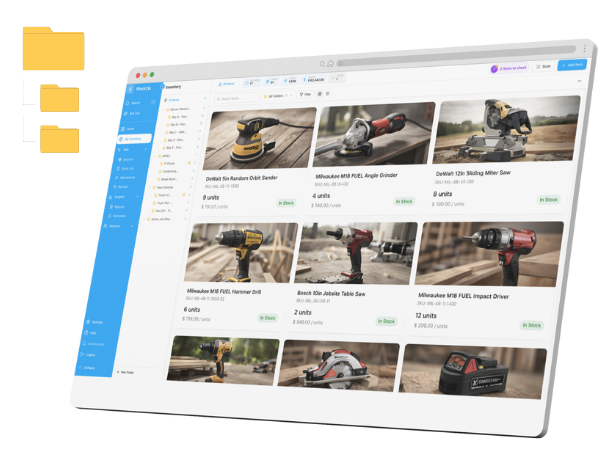
StockZip turns these terms into everyday workflows: scan to update stock, set reorder points, and get low-stock alerts. Start free — your signup price is your renewal price.
Free for 100 items
No credit card